As the nation’s affordable housing crisis persists, states and localities are beginning to experiment with new kinds of public institutions to design, finance and deliver housing. The goal of these efforts is to expand the mission and focus of housing institutions from mere implementers of federal programs and purveyors of federal resources to entities that can mobilize capital, ideas and civic energy in new and powerful ways.
One of the most promising institutional trends is the creation of public asset corporations in cities such as Atlanta, Chattanooga and Cincinnati. Modeled after successes in European cities, public asset corporations are structured both to put publicly owned land and buildings in the service of housing production and preservation and to accelerate housing development via powerful financial tools and mechanisms.
Public asset corporations can enable communities to address the housing shortage in the near term and provide a strong foundation for sustainable production over time. To that end, the National Housing Crisis Task Force published this week a Public Asset Corporation Playbook to define these new kinds of institutions, showcase emerging examples, extract core characteristics and set a path for broader aspiration, adoption and adaptation. We discuss each of these elements in turn.
Introducing/Defining Public Asset Corporations
As featured in the National Housing Crisis Task Force’s State and Local Housing Action Plan, Public Asset Corporations are entities which use the power of the public sector to expand and speed up the construction of housing. Public sector institutions, including Public Housing Authorities, often have existing powers (e.g., acquisition, development, and asset management authority, public land disposition, bond and loan issuances, etc.) that, when appropriately staffed and designed, can speed up the housing construction process, lower the cost of construction and dramatically increase the scale of housing production.
Over the past decade, a small but growing number of U.S. cities have become interested in how to leverage this institutional infrastructure to create public asset corporations. These cities have been influenced by domestic and international models, the latter of which operate on a much larger scale but provide a useful design template for how these teams can be structured in the U.S. context.
Early U.S. examples of Public Asset Corporations
The Playbook features three examples of U.S.-based public asset corporations that are already operational in Atlanta, Chattanooga and Cincinnati.
Atlanta Urban Development Corporation (AUDC): Established in 2023 as a nonprofit subsidiary within the city’s public housing authority, AUDC was designed to expand affordable housing supply, build public-sector real estate expertise, and ultimately reduce reliance on LIHTC. It is funded through a $38M mixed-income revolving loan fund and leverages bonding authority, tax exemptions, and philanthropy to support individual deals. Since 2023, the team has grown to ~18 people, who focus on transactions, public private partnerships, and community engagement.
The backbone of the AUDC portfolio is publicly owned land and buildings that are placed in the service of housing production. AUDC negotiates discounted public land contribution values that lower acquisition costs and serve as equity in the project. AUDC leverages RFQs to bring developers to the table faster and then works with them over time to narrow down the scope of the engagement, helping reduce construction timelines and therefore costs.
This quasi-public institution is acting more nimbly than typical City agencies – developers can submit any project in the city via a common intake form and the city government actively engages on how to help the project succeed. This represents a unique level of ease compared to the typical process of swinging and missing through a labyrinth of confusing subsidies.
Invest Chattanooga: Established in 2024 within the Chattanooga Housing Authority, Invest Chattanooga is a lean operation (Matt Bedsole, the current CEO, is the only full-time employee) focused on unclogging a pipeline of entitled but unfinanced developments and reducing dependence on federal funding. It is funded through a $20M mixed-income revolving loan fund, which takes a first loss position in the construction phase of each deal and leverages philanthropic funds as takeout financing once the deals convert to the permanent financing stage, the only Public Asset Corporation with this differentiated takeout structure. The model explicitly targets stalled market-rate developments, maintains public ownership through ground leases with private developers rather than building in-house capacity, and intends to expand its public land portfolio over time to help lower acquisition costs.
The Port Authority of Cincinnati: Established in 2001, Cincinnati’s Port Authority acts beyond the typical remit of port authorities by reclaiming vacant, investor-controlled, and tax-delinquent properties to expand affordable homeownership and stabilize residential neighborhoods. It operates through a network of managed entities — including a County Land Bank, a 501(c)3 homebuilder, and a CDC — that collectively handle acquisition, financing, exemptions, and redevelopment under one strategic umbrella. With roughly 50 internal staff and external partners for construction and property management, the Port’s key advantages include its ability, through the land bank, to enable large-scale scattered-site assembly, as well as a sales tax exemption that helps defray costs across its portfolio. The Port represents an alternative model to a public housing authority that can be utilized for building a Public Asset Corporation.
Core elements of public asset corporations
Public asset corporations offer cities distinctive advantages in boosting the supply of housing.
Access to state and local authorities and tools: Public asset corporations are typically situated in an existing public institution that finances housing or provides development services, such as a public housing authority, a port authority, a land bank, an economic development corporation, or a standalone quasi-public entity. The goal is for multiple roles and responsibilities that were traditionally owned by separate agencies to be consolidated under one roof to improve service delivery.
Atlanta and Chattanooga spent a great deal of time upfront assessing the roles and responsibilities of existing public entities to determine which organization would provide a new corporation with the most expansive and flexible set of powers. The goal was to increase in-house capacity across multiple functions including lending, bonding, priority bidding on public land, multifamily acquisition and ownership, commercial development, and land stewardship experience.
Both Chattanooga and Atlanta decided to situate their Public Asset Corporations in their public housing authorities. PHAs have powers to finance and lower the cost of housing by issuing tax-exempt bonds/loans for housing development, lowering transactions costs and providing tax exemptions for affordable housing. PHAs also have the authority to acquire, build, and manage housing by entering into joint ventures with private developers or acquiring and dispensing public land to meaningfully reduce acquisition costs and increase public ownership. PHAs can also ensure long-term affordability by enticing private developers to the table via ground-lease agreements, while maintaining a 51% stake in the development.
Access to low-cost capital: Public asset corporations are typically seeded with some kind of revolving capital that allows them to produce mixed-income buildings that generate large enough cash flows to cross subsidize construction and operating costs, particularly of affordable units. Both Chattanooga and Atlanta stood up revolving loan funds to serve as the primary financing vehicle, which allowed them to finance the riskiest parts of the capital stack and therefore entice investors to the table to move stalled deals forward.
These financing vehicles are highly bespoke, allowing the entities to prioritize different deal structures and capital stacks based on their individual markets, all in the name of lowering the overall cost of capital. For example, Chattanooga has a robust philanthropic community, so their revolving loan fund takes a first-loss position in the construction phase that is then supplanted by impact investor capital in the permanent financing phase, allowing public and private investments to revolve over time while creating a high-impact public private partnership. Atlanta utilizes Private Enterprise Agreements, which allow them to apply tax abatements to projects, on top of lowered acquisition costs from their use of underutilized public land, to increase cash flow and drive down the overall costs of capital.
A benefit of local funding sources is that it reduces institutional reliance on antiquated and inadequate federal funding sources. One of the driving forces behind Atlanta creating their public asset corporation was to diversify from over-prescribed federal funding sources like LIHTC. By focusing on state and local funding, public asset corporations inherently derisk themselves by owning the funding and decision-making processes, rather than being at the whim of the federal government.
Other operational advantages: Public asset corporations have other advantages over federal housing programs.
Market-orientation: Corporations leverage private sector resources for public benefit, including ground leasing land to private developers and contracting with private sector talent to build staff capacity.
Long-term affordability: Corporations can lock in long-term affordability for residents through public ownership and lower market rate rents through increased supply.
Operational Sustainability: Corporations can harness the disposition of land to lower development costs and capture a portion of appreciated value over time, serving as a continuous infusion of capital.
Mixed-income: Corporations can combine income-restricted and market rate housing to generate sustainable revenue that is reinvested to grow housing portfolios over time.
Realizing the Full Potential of Public Asset Corporations: Ireland’s Land Development Agency
U.S. public asset corporations are still in their infancy and will undoubtedly evolve and mature over the coming years. To inform that process, it is helpful to assess Public Asset Corporations along two axes around finance and development. The left axis evaluates entities on how they strategically deploy financing to produce more housing. The right axis evaluates entities on how they deploy resources to acquire, develop, and manage properties.
Entities that perform both functions can control more slivers of the construction value chain, allowing them to move faster and lower costs. Here is a graphic that plots this visually:
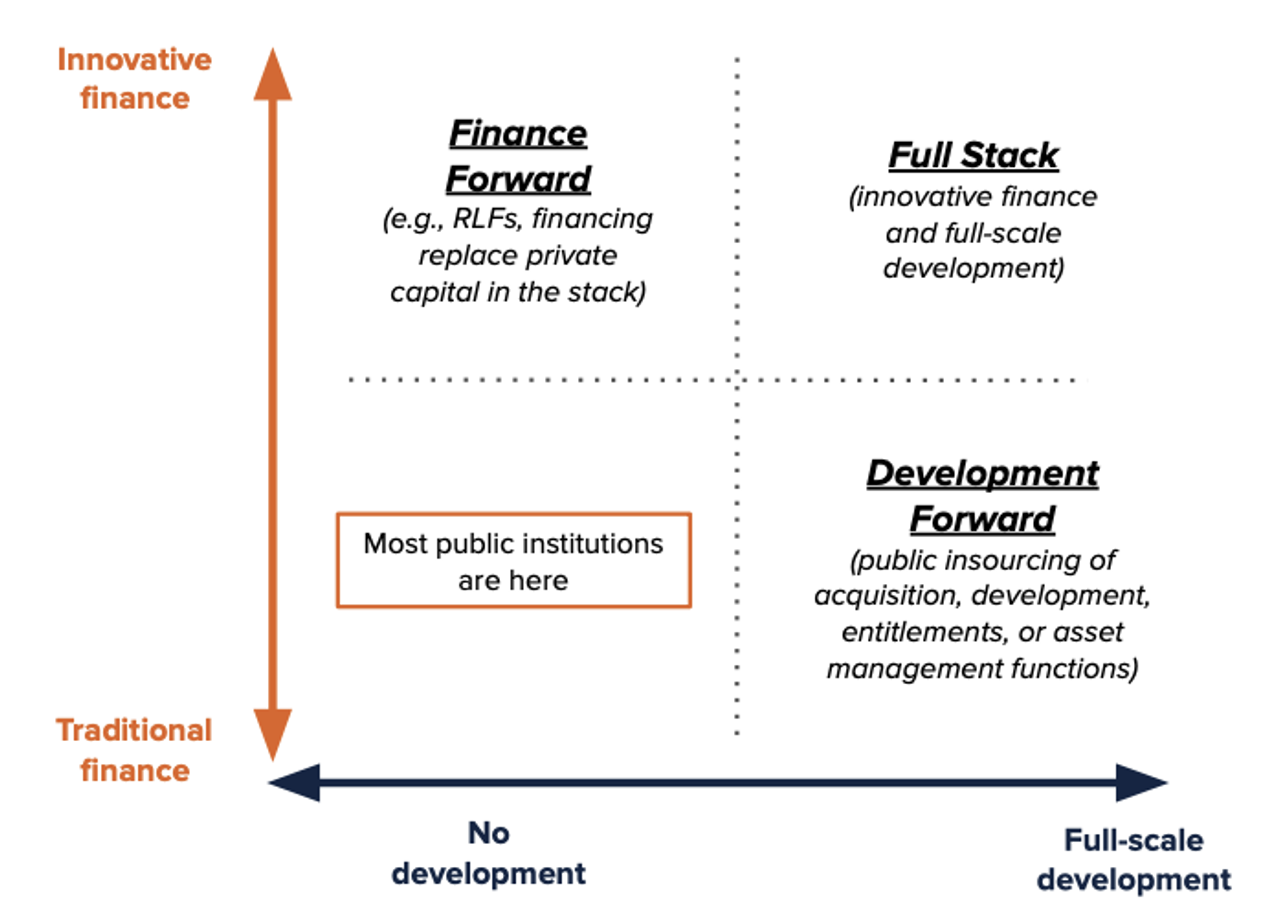
The reality today is that most public or quasi-public housing institutions are in the bottom left quadrant: they mostly utilize traditional finance and, for the most part, produce very little new housing. Our goal as a nation should be to push the level of institutional modernization further into the upper right quadrant, which would enable institutions to deploy more sophisticated and innovative financial mechanisms as well as integrate acquisition, development, and asset management functions under one roof.
Ireland’s Land Development Authority is best current international example of the full stack model. In 2021, the Irish Parliament passed the Land Development Agency Act, which codified Ireland’s Land Development Authority. The Authority was created to promote the development of affordable housing in a nation facing immense housing shortages.
The creation of the LDA was focused on three core goals: locking in affordability long-term for residents, removing acquisition costs to lower the cost of development, and creating revolving and sustainable forms of capital that would provide certainty to the market. To seed the LDA, Ireland’s Minister of Housing made a €6.5B equity investment. For perspective, Ireland’s population is around 5.5 million people, so this amounts to a roughly €1,100 per person investment across the entire country, an extraordinary level of investment in housing by U.S. standards. The LDA also has about €2.5B in borrowing capacity, but the authority is focused on the equity side of the ledger in the short term and views borrowing as a longer-term strategy.
At its core, the LDA was intentionally designed to acquire, develop, and manage mixed-income housing across the country. The LDA uses in-house capabilities to lower construction times, and therefore costs, across its entire portfolio, allowing the authority to stretch its equity investments much further. The LDA is also very intentional about maintaining 100% ownership of their properties to ensure long-term affordability for the residents. However, the majority of the LDA’s portfolio are mixed-income units, allowing the LDA to generate high enough returns (typically around 3%) to cover costs associated with their affordable units. Upon launch, the LDA was focused on leveraging public land to lower acquisition costs but has since expanded beyond public land to collaborate more with the private sector and local authorities to unlock stalled deals that lack financing. This pivot allows the LDA to act as a critical gap filler in the private sector, providing countercyclical support to the private market, rather than competing against it.
What the LDA has been able to achieve in just five years is remarkable. A team of over 270 staff has completed the construction or are currently constructing over 6,500 units, with over 25,000 units in the pipeline. This 25,000-unit pipeline equates to 25 new units authorized per 1,000 existing homes, which is a common statistic to evaluate the current level of activity in any individual housing market. Only one state in the U.S. has a number over 20 (Idaho). For comparison, current units authorized per 1,000 homes across Minnesota and Wisconsin, which are comparable in population to Ireland, would need to triple to match the LDA’s progress in just the last five years. Significantly, the LDA is just one authority in Ireland and does not include the entire private construction market, so the 25 units authorized per 1,000 existing homes is understated relative to the number of units authorized for the entire country writ large. This is a staggering level of scale that the LDA was able to achieve in just five years and shows the potential of institutional modernization as a key lever for change.
A Path Forward
The market and potential for public asset corporations are vast in the United States. There are over 3,400 public housing authorities across the United States, unveiling a large market for building public asset corporations which doesn’t even include other entities like port authorities, land banks or economic development corporations. These public entities, often neglected if not dismissed, have expansive infrastructure, powers and access to capital that can be put to work to address the nation’s housing crisis.
There is also a large amount of publicly owned land available; the federal government alone is estimated to own 200 million acres within metropolitan and micropolitan areas. While not all of this can immediately be used to develop housing, green shoots are already being identified, such as leveraging U.S. Postal Service-owned land to build more housing. In fact, Senators Chris Van Hollen (D-MD) and John Curtis (R-UT) have recently introduced legislation that would formalize a pilot program enabling the USPS to build housing on its land and use project revenues for repairs and new facility construction.
With this broader focus, Public Asset Corporations could be an important operating model for federal, state, and local organizations on the ground which need a mechanism to leverage public land for housing development. To help spread the model, the Playbook released this week provides a six-step roadmap that includes goal setting, organizational and programmatic design, staffing considerations, seed funding and incorporation steps. Now comes the hard part, ensuring that the model moves from a few first movers to a larger group of fast followers to a norm for all communities.
Many will say that this is impossible to achieve. But consider this. In the 1930s, thousands of public housing authorities were created in a world where the U.S. Postal Service was the main source of communication. We now live in an age when AI models can comb through countless laws and statutes to help localities identify latent powers and authorities and catalyze and routinize high-leverage reforms. The widespread adoption of public asset corporations is doable if we act with a level of ambition and imagination that fits the scale of the housing crisis.
Bruce Katz is the Founder of New Localism Associates and a Senior Advisor to the National Housing Crisis Task Force. Niall Dammando is a Policy Advisor at the National Housing Crisis Task Force focused on housing finance issues. Ben Preis is also a Senior Advisor to the National Housing Crisis Task Force.